How to Figure Out Your Kitchen Style (Before You Design Anything)
- Chloe Browning

- Apr 27
- 4 min read
Most people think designing a kitchen starts with cabinets, countertops, or appliances. It doesn’t.
It starts with something much more foundational—and honestly, the part most people struggle with: figuring out what you actually want your kitchen to feel like.
Before layout, before materials, before anything technical, there’s a phase that defines the entire direction of the project. This is where we eliminate confusion, narrow decisions, and create a clear path forward.
Right now, I’m in the early stages of designing a kitchen for a client here in Austin, and this post walks through exactly how we approached that first step—defining their kitchen style in a way that’s clear, actionable, and not overwhelming.
The Reality: Most Clients Don’t Know Their Style (And That’s Normal)
One of the most common things I hear from clients is:
“I have inspiration photos I love, but I don’t know if it’s right for my home.”
And they’re right to feel that way.
Most people:
Save a mix of different styles
Don’t know how those ideas translate into their own space
Haven’t thought about how design decisions connect together
So instead of expecting clients to come in with a fully formed vision, my process is built to help them discover it.
The Project: What This Kitchen Needed

This kitchen is on the smaller side—which isn’t a negative, but it does influence how we approach the design.
Since my clients don’t cook often, the priorities shifted away from oversized appliances and large prep zones, and instead focused on:
Maximizing storage in a thoughtful way
Updating materials to feel less builder-grade
Creating a more elevated, high-end look
Keeping the space feeling light and open
These priorities immediately inform the direction—but they don’t define the style yet. That’s the next step.
Step One: The Client Q&A (How We Start Defining Direction)
At the start of every project, I send a detailed client questionnaire. This isn’t just for basic preferences—it’s designed to pull out information clients don’t always know how to articulate on their own.
Some of the most important questions we use:
1. What colors are you drawn to?
For this project, my clients consistently came back to:
Blues
Greens
So instead of asking them to pick a specific color (which is too early), I created two different moodboards:
One centered around a blue kitchen
One centered around a green kitchen
The goal here isn’t to finalize a color—it’s to understand which direction feels right.


2. How do you want the space to feel?
This is one of the most important questions, and also one of the hardest for clients to answer.
For this kitchen, the words they connected with were:
Calming
Organic
Refined
Pops of color
Lighter vs. darker tones
These words become the filter for every design decision moving forward.
3. What level of detail feels right to you?
Clients often don’t realize how much variation there is within cabinetry alone.
So instead of asking directly, I show visual comparisons:
Flat panel cabinets (minimal, clean)
More detailed cabinet profiles
Hardware options:
Statement hardware
Minimal hardware
No hardware (integrated)
For this project, my clients leaned toward a more minimal approach, so I guided them toward flatter panel styles and cleaner detailing.
4. Do you want warmth (like wood) in the space?
They mentioned wanting to incorporate wood cabinetry, so I presented:
Light wood tones
Dark wood tones
Again, not choosing the exact finish—just understanding the direction and warmth level they’re drawn to.
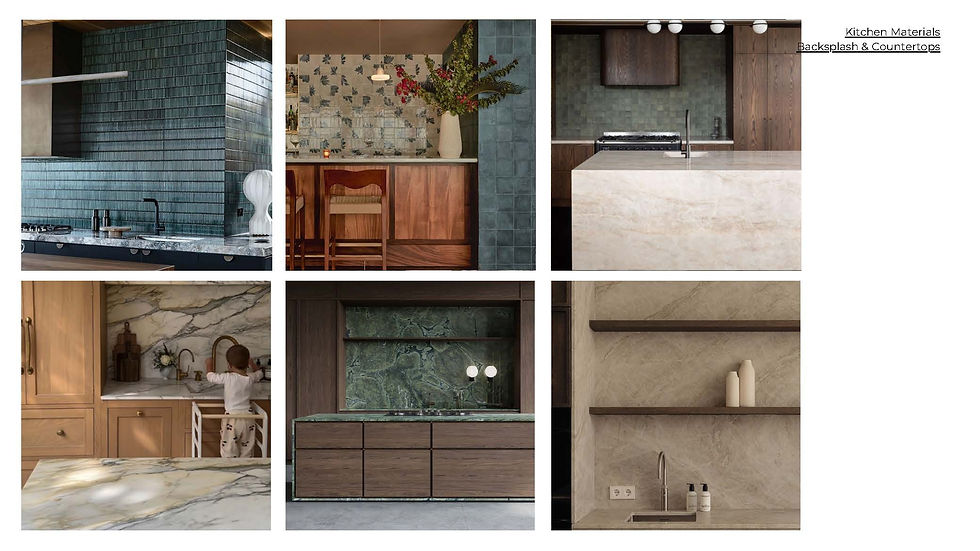
5. How expressive do you want the materials to be?
This is where we start exploring contrast and visual interest.
I showed:
Kitchens with detailed tile backsplashes
Kitchens with full slab backsplashes (more seamless and minimal)
This helps define whether the space should feel:
More layered and detailed
Or more clean and restrained
What We’re Actually Deciding in This Phase
This is the most important part to understand: We are not selecting exact finishes yet.
We are defining:
Color direction (blue vs green—not the exact shade)
Overall feeling (calm, refined, organic)
Level of contrast (light vs dark)
Cabinet style (minimal vs detailed)
Material expression (simple vs layered)
Warmth (amount of wood, tone of materials)
This creates a clear design framework. Without this step, projects tend to feel disjointed—because decisions are made individually instead of as part of a cohesive vision.
Why This Step Matters More Than People Think
Skipping this phase is one of the biggest mistakes I see.
When there’s no clear direction:
Clients second-guess every decision
Materials don’t work well together
The space ends up feeling random instead of intentional
When this phase is done correctly:
Decisions become faster and easier
The design feels cohesive from the start
The final result feels elevated—not pieced together
Designer Tips for Defining Your Kitchen Style
If everything looks good to you, you haven’t narrowed enough.Clarity comes from eliminating options, not adding more.
Focus on direction, not exact choices.You don’t need to pick the exact paint color—you need to know if you’re going light, dark, warm, or cool.
Your space matters more than the inspiration image.What works in a large, open kitchen may not work in a smaller one.
Describe your kitchen in 3–5 words.If you can’t do that, your concept isn’t clear yet.
What Comes Next
Once the concept is clearly defined, we move into schematic design—where we focus on layout, function, and flow.
This is where the kitchen starts to take shape technically:
Appliance placement
Storage planning
Cabinet layout
Circulation and usability
I’ll be breaking that down in the next post.
Final Thought
The best kitchens don’t start with finishes—they start with clarity.
If you don’t know the direction, every decision after that becomes harder than it needs to be.
Define the vision first. Everything else builds from there.


Comments